Let’s face it, college life at Carleton College or St. Olaf College in Northfield, MN, is nothing short of intense. Between juggling a mountain of coursework, trying to maintain some semblance of a social life, and maybe squeezing in a few hours of sleep, it’s no wonder students here can feel like they’re sprinting through an academic marathon—without any water breaks. If you’re a student feeling overwhelmed by the demands of these rigorous institutions, therapy could be the perfect pit stop to help you recharge and refocus.
Understanding Your Stress in College
St. Olaf and Carleton are renowned for their academic rigor. With great prestige comes great responsibility—and sometimes a ton of stress. Whether it’s the pressure to maintain a stellar GPA, the challenge of meeting tight deadlines, or the struggle to balance your studies with extracurricular activities, the demands can be overwhelming. Add in the Minnesota winters, and it’s enough to make anyone consider hibernation. But don’t worry, there’s help available!
Understanding your college stress is crucial because, believe it or not, not all stress is bad. In fact, a healthy stress can be a great motivator. It pushes you to study for exams, meet deadlines, and strive for excellence. This kind of stress, known as “eustress,” can enhance your learning and personal growth. It’s like the pressure that turns coal into diamonds—necessary and ultimately beneficial.
However, when stress starts piling up without a release valve, it can quickly become overwhelming. The rigorous academic demands at St. Olaf and Carleton, combined with social pressures and the pursuit of perfection, can tip the scales from productive stress to burnout territory. When stress reaches this level, it stops being a motivator and instead becomes a burden that hinders your ability to function effectively. Within a short amount of time, this setup will result in injuries like burnout.
Learning to manage this stress is key. Without effective coping strategies, even the most motivated student can find themselves feeling exhausted, anxious, and unable to keep up. Therapy with a clinician that understand college student mental health can be a vital resource in helping you create, and sustain, that balance between the stress that helps you thrive and the stress that drags you down.
Why Therapy?
Therapy offers a judgment-free zone where you can unload your worries, develop coping strategies, and maybe even laugh about how you once thought taking five advanced classes in a single semester was a good idea. Whether it’s managing anxiety before that big organic chemistry exam or finding ways to cope with the stress of figuring out what to do with your life after graduation, therapy can provide the support you need to thrive—not just survive—during your college years.
Therapists that have expertise in college student mental health can help you know when you are managing your stress well or when you are at risk for burnout. We can also help you understand and reduce the stress created by mental health conditions like depression, anxiety, PTSD, or ADHD in a college environment.
Individual Therapy: Tailored Support for Your Needs
Individual therapy is your personal stress-busting toolkit. Here, you get to work one-on-one with a licensed therapist who understands the unique pressures of attending a school like Carleton or St. Olaf. It’s a bit like having a personal trainer, but for your mental health, helping you build resilience, manage stress, and tackle whatever life (or that surprise pop quiz) throws your way.
Benefits of Individual Therapy:
Stress Management Techniques: Learn how to keep calm and carry on—even during finals week.
Anxiety and Depression Support: Because sometimes the pressure to be perfect can feel like it’s crushing you.
Time Management and Study Skills: For when your to-do list feels more like a to-don’t list.
Improved Self-Esteem: Boost your confidence, because you’re more than just your grades (though those are pretty great, too).
Group Therapy: Connecting with Peers
Group therapy offers a chance to commiserate with others who are in the same academic boat. It’s like a study group for your emotions—minus the textbooks and with way more empathy.
Benefits of Group Therapy:
Shared Experiences: Discover that you’re not the only one who’s been Googling “how to drop out and become a professional napper.”
Peer Support: Because sometimes it’s nice to hear “I’ve been there” from someone who actually has.
Skill-Building: Learn new ways to handle stress from both your therapist and fellow students. Plus, it’s cheaper than retail therapy.
Why Choose Therapy in Northfield?
Therapy in Northfield isn’t just convenient; it’s tailored to the unique needs of Carleton and St. Olaf students. You’ll be working with therapists who get it—they know the local culture, the academic pressures, and just how brutal those winter months can be on your mood.
Convenience: Located just a stone’s throw from campus, you won’t have to choose between therapy and your next class (but maybe between therapy and that third cup of coffee).
Local Expertise: Therapists here are well-versed in the academic challenges specific to Carleton and St. Olaf. They understand that “challenging” doesn’t begin to describe your course load.
Confidentiality: Your sessions are completely confidential, so feel free to spill the tea on whatever’s stressing you out without fear of judgment.
Taking the First Step
If you’re feeling like the stress of college is getting to be too much, it’s time to take a deep breath and consider reaching out for support. Therapy can be your secret weapon in managing stress, building resilience, and making the most out of your time at Carleton or St. Olaf.
Conclusion
College can be tough—especially at schools as demanding as Carleton and St. Olaf. But therapy can provide the support you need to not just survive, but thrive. Whether you’re struggling with academic pressures, social stress, or just trying to figure out how to adult, therapy in Northfield, MN, can help you navigate these challenges with confidence.
Call to Action
Ready to tackle college stress head-on? Contact us today to schedule a consultation and learn how therapy can help you stay balanced, focused, and have a (mostly) eustress experience during your time at Carleton or St. Olaf.
Are you looking to get insurance coverage for ADHD testing? We know it can be confusing and frustrating to figure out. But don’t worry—we’ve got you covered. Let’s break down what you need to know about insurance coverage for ADHD testing in adults.
Does Insurance Cover ADHD Testing?
Good news! Many insurance plans do cover ADHD testing. But the details can vary a lot depending on your plan. So, it’s important to check your policy to know what’s covered and what steps you need to take.
In this guide, we’ll talk about the types of insurance plans that typically cover ADHD testing, like private insurance, employer-sponsored plans, and Medicaid. We’ll also explain how insurance companies decide if you’re eligible for coverage.
Plus, we’ll give you some tips on how to handle the insurance process—like what to do before you schedule a test, how to understand copays and deductibles, and what to do if your claim gets denied.
By the end, you’ll have a clear understanding of how insurance works for ADHD testing in adults and feel confident navigating the process.
Why Is ADHD Testing Important for Adults?
ADHD isn’t just for kids! About 4-6% of adults in the U.S. have ADHD, while only about 1-2% are diagnosed. If left untreated, it can cause increasing challenges in life like trouble focusing, impulsive decisions, and difficulty staying organized. These issues can make work, relationships, and home life harder, so getting a proper diagnosis and treatment is really important.
ADHD testing for adults usually involves a mental health professional that has received training to accurately understand ADHD, like a psychologist or psychiatrist, who will do a thorough evaluation. This includes looking at your medical history, running cognitive tests, and observing your behavior. The goal is to see if you meet the criteria for ADHD and figure out the best treatment plan for you.
What Is Insurance Coverage and How Does It Work?
Insurance coverage is basically the benefits and services your health insurance plan will pay for. You pay a premium to the insurance company, and they agree to cover some of your healthcare costs.
Each insurance plan has different rules, like what services are covered, how much you’ll pay out of pocket, and which doctors you can see. Knowing these details will help you understand how your insurance will handle ADHD testing.
How Insurance Covers ADHD Testing in Adults
Insurance coverage for ADHD testing can vary widely. Some plans might cover the whole cost, while others might only cover part of it, leaving you to pay the rest. It’s crucial to talk to your insurance provider to find out what your specific plan covers.
Insurance companies might also have certain requirements for covering ADHD testing. For example, you might need a referral from your primary care doctor or proof that you’ve had ADHD symptoms in the past. Knowing these rules can help you avoid surprises when you file a claim.
Types of Insurance That May Cover ADHD Testing
Here are some common types of insurance plans that might cover ADHD testing:
Private Health Insurance: Many private plans, including those from employers or the health insurance marketplace, cover ADHD testing. But the specifics can vary.
Employer-Sponsored Plans: If you get your insurance through work, check your benefits package. ADHD testing might be covered.
Medicaid: In some states, Medicaid covers ADHD testing for adults. Coverage and eligibility can differ by state, so it’s worth looking into.
Medicare: If you’re 65 or older or have certain disabilities, Medicare might cover some ADHD testing costs. The details can be tricky, so you might need to do some extra research.
Understanding your insurance options will help you find the best coverage for ADHD testing.
How to Get Insurance Coverage for ADHD Testing
Getting insurance to cover ADHD testing can be a bit tricky, but here’s a general guide to help you out:
Review Your Policy: Start by reading your insurance policy carefully. Know what’s covered, your deductible, and any other costs.
Talk to Your Doctor: Discuss your ADHD concerns with your doctor. They can refer you for testing and help with the insurance process.
Get Pre-Authorization: Some insurance plans need you to get approval before they’ll cover the test. Work with your doctor to get this done.
Submit a Claim: After the test, you or your doctor will submit a claim to your insurance. Make sure all the paperwork is in order.
Follow Up: If your claim is denied, don’t give up! Follow up with your insurance company, and be ready to appeal if needed.
Being proactive and organized can help you get the coverage you need.
Tips for Navigating Insurance for ADHD Testing
Navigating insurance can be a headache, but here are some tips to make it easier:
Know Your Policy: Understand your insurance plan inside and out, especially when it comes to ADHD testing.
Communicate with Your Doctor: Make sure your doctor knows the insurance requirements and can provide the right documentation.
Advocate for Yourself: If you hit any roadblocks, don’t be afraid to speak up. You have the right to appeal decisions.
Look for Other Payment Options: If insurance doesn’t cover everything, ask about payment plans, sliding-scale fees, or financial aid.
Seek Support: Connect with ADHD support groups or online communities for advice and guidance.
Using these tips will help you get through the insurance process with less stress.
What to Do If Insurance Won’t Cover ADHD Testing
If your insurance won’t cover ADHD testing, there are still options:
Sliding-Scale Clinics: Some clinics offer services at a reduced cost based on your income.
University Programs: Some teaching hospitals and universities provide testing at lower costs as part of training programs.
Payment Plans: Ask your healthcare provider if they offer payment plans to spread out the cost.
Crowdfunding: If needed, consider using crowdfunding platforms to raise money for the test.
Exploring these options can help make ADHD testing more affordable.
Will my health insurance cover costs if I do my ADHD test at your clinic?
Hopefully. Like we mentioned in this article, it all depends on your health insurance plan. Please contact your health insurance to see if you would receive any reimbursement if you submit a claim for ADHD testing. Usually the best way to verify your benefits is to call the number on the back of your insurance card and ask a representative the following questions:
(1) Is ADHD assessment covered in my plan?
(2) If so, are there any steps I need to take in order for it to be covered(pre-authorization, referral from primary care physician, etc.)?
(3) Do I need to meet my yearly deductible before an ADHD assessment is covered? (If so, can you please explain to me how my deductible works?)
(4) How much would be covered if I do the assessment at Northfield Dynamic Therapy, which would be considered “out-of-network”?Note -the example superbill (below) has all the information your insurance company might want to know.
(5) If ADHD assessment is not covered, will it still count toward my deductible if I submit a documentation of payment?
We are more than happy to help you sort through this process of verifying benefits. We never want you to get into a situation where you don’t know exactly what to expect regarding payment.
Please go to our ADHD Testing webpage to see an example Superbill that you can use when calling your health insurance. It includes all the information your health insurance will need about our practice.
Conclusion: The Importance of Advocating for ADHD Testing Coverage
Getting tested for ADHD as an adult is important for your health and well-being. But dealing with insurance can be tough. By understanding your coverage, working with your doctor, and advocating for yourself, you can get the support you need.
Remember, ADHD is a legitimate condition that affects adults, and you deserve the right care. So, don’t hesitate to push for the coverage and treatment that can help you live your best life.
About Dr. Nate Page
Hello! I am a neurodiversity-affirming licensed psychologist who specializes in online testing for adults that are exploring the possibility of formal ADHD and/or autism diagnosis. Recently, my license has been extended to 41 states in the US, and so if you reside in one of those states I would be able to work with you (you can see a map on my website). I currently have openings!
Sure I have some fancy titles (PhD, licensed psychologist, certified group psychotherapist) but most of my education on neurodiversity has come through my own journey being diagnosed with ADHD at age 38.
If you suspect that you or a loved one may have Attention-Deficit/Hyperactivity Disorder (ADHD), getting a proper diagnosis is a crucial first step on the path towards managing and treating the condition. But how do you go about finding ADHD testing near you? In this article, we will guide you through the process of unlocking the path to diagnosis and help you locate reputable testing options in your area.
Whether you are a concerned parent seeking answers for your child or an adult who suspects that ADHD may be affecting your daily life, understanding the diagnostic process is essential. We will explore the different types of assessments and evaluations used to diagnose ADHD, including psychological testing, medical evaluations, and interviews with healthcare professionals.
Additionally, we will discuss the importance of choosing a qualified healthcare provider or specialist who is experienced in diagnosing and treating ADHD. By finding the right expert near you, you can ensure a thorough and accurate diagnosis, leading to the best possible care and support for yourself or your loved one.
Don’t let the uncertainty of an undiagnosed condition hold you back. Read on to discover the steps you can take to find ADHD testing near you and unlock a clearer path towards managing your symptoms and improving your quality of life.
What is ADHD?
ADHD, or Attention-Deficit/Hyperactivity Disorder, is a neurodevelopmental condition that affects a person’s ability to focus, control impulsive behaviors, and manage their level of activity. It is characterized by a persistent pattern of inattention, hyperactivity, and/or impulsivity that can interfere with an individual’s daily life, including their academic, social, and professional functioning. Ideally ADHD would be diagnosed in childhood, but it often is not identified until adulthood. Understanding the core symptoms of ADHD is crucial in recognizing the condition and seeking the appropriate support and treatment.
ADHD is a complex disorder that involves a combination of genetic, environmental, and neurological factors. Research suggests that individuals with ADHD may have differences in the way their brain processes and regulates certain neurotransmitters, such as dopamine and norepinephrine, which play a vital role in attention, concentration, and impulse control. These neurological differences can lead to the characteristic symptoms of ADHD, which can present differently in each person, depending on their age, gender, and individual circumstances.
It is important to note that ADHD is not a sign of laziness, lack of intelligence, or a personal flaw. It is a recognized medical condition that requires proper assessment, diagnosis, and comprehensive treatment to help individuals manage their symptoms and thrive in various aspects of their lives. With the right support and strategies, individuals with ADHD can develop effective coping mechanisms, enhance their strengths, and lead fulfilling and successful lives.
Signs and symptoms of ADHD
The primary symptoms of ADHD can be divided into three main categories: inattention, hyperactivity, and impulsivity. These symptoms can manifest differently in each individual, and the severity can vary depending on the person’s age, gender, and specific circumstances.
Inattention is a core feature of ADHD, and it can be characterized by difficulty focusing on tasks, frequently losing focus or becoming easily distracted, struggling to follow instructions or complete assignments, and appearing disorganized or forgetful. Individuals with ADHD may also have trouble staying on track during conversations, frequently shifting from one task to another, and having difficulty remembering important information.
Hyperactivity is another hallmark symptom of ADHD, and it can present as restlessness, fidgeting, excessive talking, and an inability to sit still for extended periods. Children with ADHD may have difficulty playing quietly or engaging in leisure activities, while adults may experience a constant sense of inner restlessness or the need to be in motion.
Impulsivity is the third major symptom of ADHD, and it can manifest as difficulty waiting one’s turn, interrupting others, making hasty decisions without considering the consequences, and engaging in risky or potentially dangerous behaviors. Individuals with ADHD may also struggle with emotional regulation, experiencing sudden mood swings or difficulty controlling their reactions to various situations.
It is important to note that these symptoms can vary in intensity and presentation depending on the individual, and they may not always be present in every situation. Additionally, some individuals with ADHD may exhibit a combination of these symptoms, while others may primarily experience one or two of the core characteristics. Understanding the diverse nature of ADHD symptoms is crucial in seeking an accurate diagnosis and developing an effective treatment plan.
The importance of getting tested for ADHD
Obtaining a proper diagnosis for ADHD is essential for several reasons. First and foremost, a comprehensive evaluation can help to confirm or rule out the presence of ADHD, providing clarity and direction for the individual and their loved ones. Without a formal diagnosis, it can be challenging to access the appropriate support, resources, and treatment options that can significantly improve the quality of life for those affected by ADHD.
Getting tested for ADHD can also lead to a better understanding of the individual’s unique strengths and challenges. A thorough assessment often includes a combination of psychological testing, medical evaluations, and interviews with healthcare professionals, which can provide valuable insights into an individual’s cognitive abilities, executive functioning skills, and overall mental health. This information can then be used to develop personalized strategies and interventions to help manage the symptoms of ADHD and maximize the individual’s potential.
Furthermore, a diagnosis of ADHD can open the door to accessing various accommodations, therapies, and educational support services that can make a significant difference in an individual’s academic, professional, and personal life. For example, students with ADHD may be eligible for special accommodations, such as extended time on tests, the use of assistive technology, or a quieter testing environment. Similarly, adults with ADHD may benefit from workplace accommodations, counseling, or coaching to help them navigate the challenges they face in their daily lives.
Ultimately, getting tested for ADHD is the first step towards knowing what treatment options would be best for you. By understanding the nature and extent of the condition, individuals can take proactive steps to manage their symptoms, develop effective coping strategies, and work towards achieving their goals and aspirations. With the right support and resources, individuals with ADHD can thrive and lead fulfilling lives.
The process of diagnosing ADHD
Diagnosing ADHD involves a comprehensive evaluation by a qualified healthcare professional, such as a psychiatrist, psychologist, or pediatrician. The diagnostic process typically includes several components to ensure an accurate assessment of the individual’s symptoms, medical history, and overall functioning.
The first step in the diagnostic process is a thorough clinical interview, during which the healthcare provider will gather information about the individual’s developmental history, current symptoms, and the impact of those symptoms on their daily life. This interview may involve conversations with the individual, as well as their family members or significant others, to gain a comprehensive understanding of the individual’s experiences and challenges.
In addition to the clinical interview, the diagnostic process often includes psychological testing and assessment. This may involve the administration of standardized questionnaires, rating scales, and cognitive tests that measure various aspects of attention, concentration, memory, and executive functioning. These assessments can help to identify the specific areas of difficulty and rule out any co-occurring conditions that may be contributing to the individual’s symptoms.
Medical evaluations, such as physical examinations and laboratory tests, are also an important part of the diagnostic process. These assessments can help to identify any underlying medical conditions or neurological factors that may be contributing to the individual’s ADHD-like symptoms. In some cases, the healthcare provider may also order brain imaging tests, such as an MRI or EEG, to gather additional information about the individual’s brain structure and function.
Throughout the diagnostic process, the healthcare provider will carefully consider the individual’s symptoms, medical history, and the results of the various assessments to determine whether the criteria for an ADHD diagnosis are met. This comprehensive approach helps to ensure that the diagnosis is accurate and that the individual receives the appropriate treatment and support moving forward.
Where to find ADHD testing near you
Finding ADHD testing near you is an important step in the process of obtaining a diagnosis and accessing the necessary support and resources. There are several options available for individuals seeking ADHD evaluation and assessment, and the choice of provider will depend on factors such as the individual’s age, insurance coverage, and the availability of services in their local area.
One of the most common places to find ADHD testing is through a primary care physician or pediatrician. These healthcare providers can often conduct an initial evaluation and provide a referral to a specialist, such as a child psychiatrist or psychologist, for a more comprehensive assessment. This can be a convenient option, as the individual’s primary care provider is likely already familiar with their medical history and can help to coordinate the diagnostic process.
Another option for ADHD testing is through a specialized ADHD or mental health clinic or center. These facilities often have teams of healthcare professionals, including psychologists, therapists, and psychiatrists, who are specifically trained in the assessment and treatment of ADHD. These centers may offer a range of services, such as psychological testing, medication management, and behavioral therapy, all under one roof.
For individuals who prefer a more individualized approach, private practice psychologists or psychiatrists who specialize in ADHD may be an excellent choice. These healthcare providers can conduct a thorough evaluation and work closely with the individual to develop a personalized treatment plan. While private practice options may involve higher out-of-pocket costs, they can often provide a more tailored and comprehensive assessment experience.
In addition to traditional healthcare providers, some school districts or educational institutions may also offer ADHD testing and evaluation services, particularly for children and adolescents. This can be a valuable resource for parents who are concerned about their child’s academic and social functioning, as the school-based assessment can provide insights into the individual’s learning needs and the development of appropriate accommodations.
When searching for ADHD testing near you, it’s important to consider factors such as the provider’s qualifications, experience, and approach to assessment and treatment. Researching local options, checking with your insurance provider, and asking for recommendations from trusted healthcare professionals or community resources can help you find the right ADHD testing center for your needs.
Factors to consider when choosing an ADHD testing professional
When searching for an ADHD testing center, it’s essential to consider several factors to ensure that you or your loved one receives a thorough and accurate assessment. Here are some key factors to keep in mind:
Qualifications and experience of the healthcare provider: Look for a testing center that employs qualified healthcare professionals, such as psychologists, psychiatrists, or pediatricians, who have specialized training and extensive experience in diagnosing and treating ADHD. These providers should have a deep understanding of the latest research, assessment methods, and evidence-based treatments for the condition.
Comprehensive assessment approach: The ADHD testing center should use a multi-faceted approach that includes a clinical interview, psychological testing, medical evaluation, and, if necessary, input from teachers, family members, or other relevant individuals. This comprehensive assessment helps to rule out any co-occurring conditions and ensures a accurate diagnosis.
Individualized treatment planning: After the assessment, the testing center should work with the individual to develop a personalized treatment plan that addresses their unique needs, strengths, and challenges. This may include recommendations for therapy, medication management, educational accommodations, or other supportive interventions.
Accessibility and convenience: Consider the location, hours of operation, and accessibility of the ADHD testing center. It’s important to choose a center that is convenient for you or your loved one to access, as this can make the diagnostic process less stressful and more manageable.
Positive patient experience: Look for an ADHD testing center that prioritizes patient comfort, empathy, and clear communication throughout the assessment process. The healthcare providers should be responsive to your questions and concerns and help you understand the next steps in managing the condition.
Insurance coverage and cost: Inquire about the testing center’s accepted insurance plans and any out-of-pocket costs associated with the assessment. This information can help you make an informed decision and ensure that the testing is accessible and affordable for you or your family.
By considering these factors, you can find an ADHD testing center that provides a comprehensive, personalized, and supportive experience, ultimately leading to a more accurate diagnosis and effective treatment plan.
The cost of ADHD testing and insurance coverage
The cost of ADHD testing can vary significantly depending on several factors, including the type of healthcare provider, the specific tests and assessments involved, and the individual’s insurance coverage. Understanding the potential costs and exploring options for insurance coverage can help individuals and families plan for and access the necessary ADHD evaluation and diagnosis.
The baseline cost of an ADHD assessment can range from a few hundred dollars to several thousand dollars, depending on the scope of the evaluation. A comprehensive assessment conducted by a licensed psychologist or psychiatrist may cost between $1,000 to $5,000 or more. This can include the initial clinical interview, psychological testing, medical examinations, and any necessary follow-up appointments.
For individuals with health insurance, the cost of ADHD testing may be partially or fully covered, depending on the specifics of their plan. Many insurance providers recognize ADHD as a medical condition and will cover the assessment and diagnostic process, as long as it is deemed medically necessary by a qualified healthcare provider. However, the level of coverage can vary, and individuals may still be responsible for deductibles, copays, or coinsurance payments.
It’s important to check with your insurance provider to understand the details of your coverage for ADHD testing. Here at Northfield Dynamic Therapy, Dr. Nate Page asks his clients to contact their insurance and ask the following questions:
(1) Is ADHD assessment covered in my plan?
(2) If so, are there any steps I need to take in order for it to be covered (pre-authorization, referral from primary care physician, etc.)?
(3) Do I need to meet my yearly deductible before an ADHD assessment is covered? (If so, can you please explain to me how my deductible works?)
(4) How much would be reimbursed if I do the assessment at a clinic that is “out-of-network”?
(5) If ADHD assessment is not covered, will it still count toward my deductible if I submit a documentation of payment?
In addition to insurance coverage, there may be other options available to help offset the cost of ADHD testing. Some healthcare providers or testing centers offer sliding-scale fees or payment plans based on the individual’s financial situation. Additionally, some organizations or non-profit groups may provide financial assistance or subsidies for ADHD assessments, particularly for those who are uninsured or underinsured.
By understanding the potential costs and exploring various options for insurance coverage and financial assistance, individuals can make informed decisions and access the ADHD testing and diagnostic services they need to manage their condition effectively.
Tips for preparing for an ADHD test
Preparing for an ADHD test can help ensure a smooth and productive assessment experience. Here are some tips to keep in mind:
Gather relevant information: Collect any medical records, school reports, or other documentation that may be relevant to the assessment. This can include past evaluations, report cards, or notes from teachers or healthcare providers. Having this information on hand can help the healthcare provider gain a more comprehensive understanding of your or your child’s history and symptoms.
Make a list of your concerns and questions: Before the appointment, take some time to reflect on the specific challenges you or your loved one are facing. Make a list of your concerns, questions, and any goals you have for the assessment and treatment process. This can help you communicate effectively with the healthcare provider and ensure that all of your needs are addressed.
Inform the provider about any accommodations: If you or your child requires any special accommodations, such as extra time, a quiet testing environment, or the use of assistive technology, be sure to inform the healthcare provider in advance. This will help them to make the necessary arrangements and ensure a comfortable and productive assessment experience.
Prepare for the interview: The clinical interview is a crucial part of the ADHD assessment process. Be prepared to provide detailed information about your or your child’s developmental history, current symptoms, and the impact of those symptoms on daily life. It may be helpful to involve family members or other caregivers in this process to provide a well-rounded perspective.
Ensure a good night’s sleep and nourishment: On the day of the assessment, make sure to get a good night’s sleep and have a nutritious meal or snack. This can help you or your child feel more alert, focused, and able to fully engage in the testing process.
Bring any necessary items: Depending on the specific assessment, you may need to bring certain items, such as eyeglasses, hearing aids, or fidget toys. Check with the healthcare provider in advance to ensure that you are prepared.
By taking these steps to prepare for the ADHD test, you can help ensure that the assessment process is as smooth and productive as possible, ultimately leading to a more accurate diagnosis and effective treatment plan.
What to expect during an ADHD test
The ADHD testing process can vary depending on the healthcare provider and the specific assessment tools they use, but there are some common elements that individuals can expect during the evaluation. Understanding what to expect can help alleviate any anxiety or uncertainty about the process.
Clinical interview: The assessment typically begins with a comprehensive clinical interview, during which the healthcare provider will gather detailed information about the individual’s developmental history, current symptoms, and the impact of those symptoms on daily life. This interview may involve both the individual and their family members or caregivers.
Psychological testing: The ADHD assessment often includes a series of standardized psychological tests and questionnaires designed to measure various aspects of attention, memory, impulse control, and executive functioning. These tests may involve tasks such as completing puzzles, responding to visual or auditory stimuli, or answering questions about behavior and emotions.
Medical evaluation: In some cases, the ADHD assessment may also include a medical evaluation, such as a physical examination, neurological assessment, or laboratory tests to rule out any underlying medical conditions that could be contributing to the individual’s symptoms.
Behavioral observations: The healthcare provider may observe the individual’s behavior and interactions during the assessment, taking note of any patterns of inattention, hyperactivity, or impulsivity that could be indicative of ADHD.
Collateral information: The healthcare provider may also gather information from other sources, such as teachers, employers, or previous healthcare providers, to gain a more comprehensive understanding of the individual’s symptoms and functioning in different environments.
Feedback and treatment planning: Once the assessment is complete, the healthcare provider will review the findings and provide feedback to the individual and their family. This may include a diagnosis of ADHD, as well as recommendations for treatment, such as medication management, therapy, or educational accommodations.
Throughout the assessment process, the healthcare provider will strive to create a comfortable and supportive environment, encouraging the individual to be open and honest about their experiences. By understanding what to expect during the ADHD test, individuals can feel more prepared and empowered to actively participate in the diagnostic process.
Can I do my ADHD test with your clinic?
Hopefully! Dr. Nate Page is licensed to conduct online ADHD and autism testing with adults in 41 states (see the map below). You can read full details on Dr. Page’s testing process on the Northfield Dyanic Therapy webpage or go ahead and schedule your 3-hour ADHD testing block (or a free 15 minute consultation) through Dr. Page online booking portal.
Dr. Page is licensed in 41 states and can conduct virtual ADHD and Autism with residence of these states.
Conclusion: Taking the first step towards managing ADHD
Seeking an ADHD diagnosis can be a significant step, but it is a crucial one in unlocking the path towards effective management and improved quality of life. If you believe that our clinic is a good fit for your ADHD testing needs, please reach out!
About Me
Hello! I am a neurodiversity-affirming licensed psychologist who specializes in online testing for adults that are exploring the possibility of formal ADHD and/or autism diagnosis. Recently, my license has been extended to 41 states in the US, and so if you reside in one of those states I would be able to work with you (you can see a map on my website). I currently have openings!
Sure I have some fancy titles (PhD, licensed psychologist, certified group psychotherapist) but most of my education on neurodiversity has come through my own journey being diagnosed with ADHD at age 38.
The musician Prince once joked with Oprah that he’d always live in Minnesota because “it’s so cold it keeps the bad people out.” But does that mean there are no bad therapists in Minnesota? While that may or may not be true, the more pressing reality is the challenge of finding a therapist who truly meets your unique needs. This process can feel overwhelming, especially when you’re facing real pain and uncertainty. Many people grapple with financial pressures and the urgent need to connect with someone who understands their specific challenges. It might seem like many therapists are fully booked, don’t accept your insurance, or simply don’t return your calls. This guide aims to equip you with essential tools and resources to help you find the right mental health care provider for your needs in Minnesota, so you can take that important step toward healing.
Where Can I Find Therapists Near Me?
Online Directories
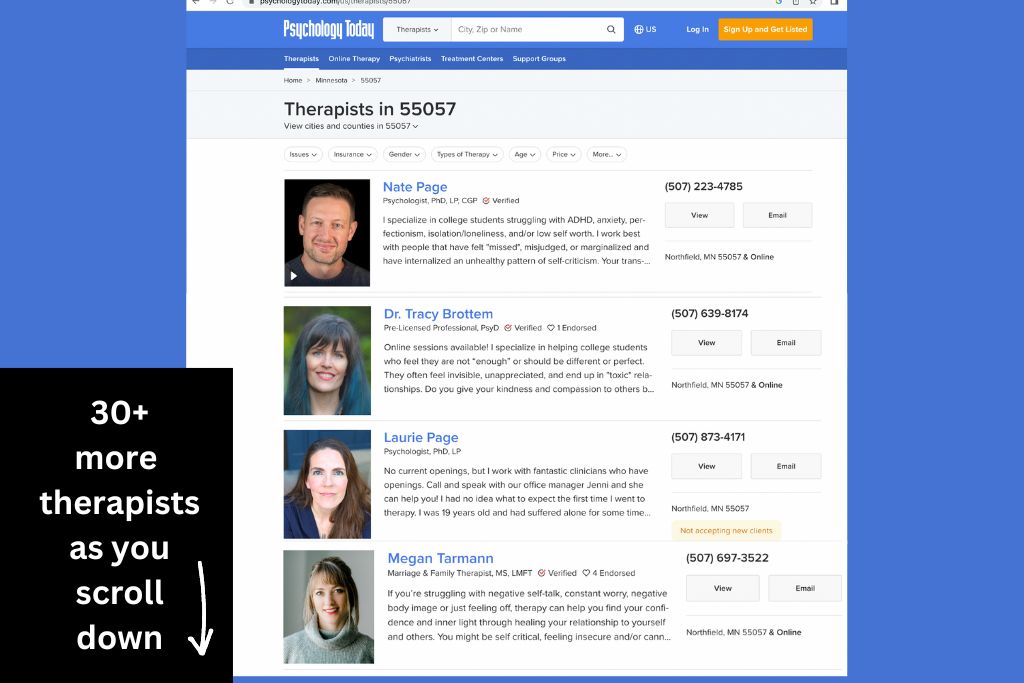
Start your search with a simple Google search for “therapists near me.” This will direct you to various therapist directories, allowing you to enter your zip code and filter results based on your specific needs. One of the most popular directories is Psychology Today, where you can specify the type of therapy you’re seeking and which health insurances are accepted.
For example, here is an image showing the results when I searched for therapists in my town Northfield, Minnesota (zip code 55057). Psychology Today pulled up a list of 30+ Minnesota therapists accepting new clients.
Here are some additional therapist directories to consider:
If you plan to use health insurance, it’s wise to check your insurance provider’s directory. This can help you find a therapist that is in-network and accepts your plan. Be aware, however, that some therapists may not be accepting new clients.
If you plan to use your health insurance to meet with an out-of-network provider (a clinician that does not have a contract with your health insurance), we recommend asking your health insurance representative the following questions to maximize your insurance benefits:
(1) What is my out-of-network coverage for outpatient mental health visits?
(2) Is there a deductible that needs to be met prior to services? How much of my deductible has been met this year?
(3) Is there a limit on the number of sessions my plan will cover per year? If Yes, How many?
(4) Is there an “allowed” amount that would be reimbursed.
(5) Do I need pre-authorization in order to start therapy? For example, do I need a referral from an in-network provider or a primary care physician to see someone out-of-network?
(6) How do I submit claims for out-of-network reimbursement?
(7) Are virtual outpatient mental health visits (or tele-therapy) covered by my plan?
(8) I have an example superbill here from my therapist. Can you tell me exactly how much I would be reimbursed for the following services (individual, group, couples therapy)?
(9) Is there anything else I need to know about utilizing my out of network benefits (limitations, rules, or other “small print” things to know).
Get Referrals from Trusted Friends and Family
Word-of-mouth can be invaluable when searching for a therapist. Friends and family may have personal experiences to share, leading you to therapists who don’t advertise extensively online.
Additionally, consider posting in online forums or local community groups. Many people feel comfortable asking for therapist recommendations anonymously, which can yield helpful suggestions.
Connect with Organizations Related to Your Concern
If you are seeking therapy for a specific issue—such as depression, anxiety, or trauma—look for organizations dedicated to those areas. For example, individuals seeking ADHD support can find valuable resources on the CHADD website, which also has local affiliate chapters in many states. Here in Minnesota you can attend the Twin Cities Southwest Metro ADHD Connection Meetings in the Eden Prairie Mall on Monday evenings. The people in these organizations can provide you invaluable information, and help you connect with therapists that can meet your needs.
Here are a few more organizations that provide therapist directories or support:
The Trevor Project (866) 488-7386 24/7 support for LGBTQ+ persons through phone (see above number), internet messaging, and text messaging (text START to 678-678). There are additional resources are on their website.
Trans Lifeline (877) 565-8860 A hotline and non-profit organization “offering direct emotional and financial support to trans people in crisis – for the trans community, by the trans community”. Callers can connect with support staff who speak Spanish.
The Asexual Visibility and Education Network (AVEN) Informational resources for people who identify as asexual or are questioning. AVEN also includes information about romantic orientations (e.g., aromatic, grayromantic, and demiromantic).
Rest For Resistance Narratives of queer persons of color written by queer persons of color.
National Queer Asian Pacific Islander Alliance A collection of LGBTQ+ Asian American, South Asian, Southeast Asian, and Pacific Islander organizations who aim to “promote visibility, educate our community, enhance grassroots organizing, expand collaborations, and challenge anti-LGBTQ bias and racism.”
South Central Minnesota Pride A non-profit organization whose mission is to promote pride and visibility for LGBTQ and allied communities in South Central Minnesota. Each fall they run a pride festival in Mankato.
Transmission Ministry Collective “Transmission Ministry Collective is an online community dedicated to the spiritual care, faith formation, and leadership potential of transgender, nonbinary, and gender-expansive Christians.” This organization hosts peer-run online support groups for general trans and nonbinary folx, trans Christians of color, and a gender exploration group for anyone who think they don’t “fit entirely in the cisgender box”. Other services include LGBTQ+ Bible studies, workshops, resources for family members of trans and gender expansive folx, and resources for ministry professionals.
OutFront Minnesota OutFront Minnesota serves the GLBT and allied communities of Minnesota with a wide variety of programs and services (612) 822-0127
Transforming Families Minnesota Support for transgender, gender-nonconforming, and gender questioning youth and their families to come together. (612) 321-8416
Talk To Potential Therapists
Hopefully this article has helped you FIND some potential therapists. Now it is time to reach out to them to see who is available for an initial consultation. Many therapists offer a free 10-15 minute consultation to determine if they’re a good fit for your needs. Don’t hesitate to “shop around” and meet with several therapists to see who you feel most comfortable with.
You never know if a therapist is available until they reach back out to you after you call, text, email or send in a contact form on their website. It is surprising how many therapists don’t respond to inquiries from potential clients. Sometimes therapists are so busy meeting with clients all day and attending to their own lives in the evenings that they are unavailable to return phone messages until late in the evening or a few days later. So, my recommendation is to reach out to a handful of therapists and see how many are available to do an initial consultation with you.
Finding Low-Cost or Free Therapy Options
If you are in need of low-cost or free therapy, resources are available. Check out this video I made afew years ago with eight helpful tips.
Conclusion
I wish you the best of luck in your search for a therapist! Finding the right therapist in Minnesota doesn’t have to be daunting. With the right resources and a bit of patience, you can discover a mental health professional who meets your needs.
At Northfield Dynamic Therapy, we offer online therapy services for adults throughout Minnesota, along with ADHD and autism testing. Visit our website to learn more about our services and schedule your free consultation today!
Are you an adult in Minnesota struggling with symptoms of ADHD and looking to get a diagnosis? This guide provides an overview of the steps involved in finding ADHD testing services as an adult in Minnesota.
Get Familiar with Adult ADHD Symptoms.
Probably the first step to getting tested for adult ADHD is learning for yourself about all of the potential signs and symptoms. Research and consult with your primary care doctor and/or therapist about what might be causing your poor concentration, restlessness, impulsivity, or difficulty completing tasks. you also want to think about how you were as a child. Here are some of the ways you might see evidence of ADHD in your life:
Often fails to give close attention to details or makes careless mistakes in schoolwork, at work, or with other activities.
Often has trouble holding attention on tasks or play activities.
Often does not seem to listen when spoken to directly.
Often does not follow through on instructions and fails to finish schoolwork, chores, or duties in the workplace (e.g., loses focus, side-tracked).
Often has trouble organizing tasks and activities.
Often avoids, dislikes, or is reluctant to do tasks that require mental effort over a long period of time (such as schoolwork or homework).
Often loses things necessary for tasks and activities (e.g. school materials, pencils, books, tools, wallets, keys, paperwork, eyeglasses, mobile telephones).
Is often easily distracted
Is often forgetful in daily activities.
Often fidgets with or taps hands or feet, or squirms in seat.
Often leaves seat in situations when remaining seated is expected.
Often runs about or climbs in situations where it is not appropriate (adolescents or adults may be limited to feeling restless).
Often unable to play or take part in leisure activities quietly.
Is often “on the go” acting as if “driven by a motor”.
Often talks excessively.
Often blurts out an answer before a question has been completed.
Often has trouble waiting their turn.
Often interrupts or intrudes on others (e.g., butts into conversations or games)
If you suspect that you have ADHD, you will need to speak to an experienced mental health professional can help you determine the correct diagnosis for your concerns.
Who Can Diagnose ADHD in Adults?
Anyone who is a licensed mental health provider can technically diagnose ADHD, but most won’t do it. Instead, they will refer you to an ADHD specialist for a formal assessment. Usually psychologists (like us here at Northfield Dynamic Therapy) are those that conduct psychological testing. Sometimes psychiatrists, primary care doctors, psychiatric nurse providers, clinical social workers, marriage and family therapists, or professional counselors will provide an ADHD diagnosis, but usually only if they have received specialized training in ADHD diagnosis.
How can I Find a Qualified Mental Health Professional that will Diagnose ADHD
A simple google search for “adult ADHD testing near me” might be the easiest first step for finding a professional who can diagnose ADHD. It is important to look for a professional that states they understand ADHD and have experience conducting assessments for adult patients.
Another great resource is the organization CHADD (Children and Adults with Attention-Deficit/Hyperactive Disorder). On their website, CHADD has a wonderful professional directory organized by zip code. The professionals listed on their website all specialize in ADHD. You can also find your local CHADD affiliate on their website and then ask community members about local professionals that provide ADHD testing and diagnostic services. You can also learn a great deal from these affiliate communities about which clinics and professionals are good ADHD medication prescribers, therapists, and coaches. Unfortunately, many people with ADHD initially connect with providers that don’t understand
Additionally, you can ask your physician for a referral for ADHD testing. Most physicians will probably have a list of who they trust to perform formal ADHD evaluations.
Finally, you can ask your health insurance. Usually, the best approach is to call up your health insurance and ask for a list of professionals that provide ADHD testing. You can also ask if, and how much, of the ADHD assessment will be covered by your insurance (and if you have any steps you need to take to make sure the costs are covered). Here are some other helpful questions to ask your health insurance:
(1) Is ADHD assessment covered in my plan?
(2) If so, are there any steps I need to take in order for it to be covered (pre-authorization, referral from primary care physician, etc.)?
(3) Do I need to meet my yearly deductible before an ADHD assessment is covered? (If so, can you please explain to me how my deductible works?)
(4) How much would be covered if I do the assessment with Dr. _____ and the _____ clinic?
(5) If ADHD assessment is not covered, will it still count toward my deductible if I submit a documentation of payment?
If cost is an issue, you can sometimes find local university psychology departments and clinics with training programs. These places often offer evaluation services at competitive prices as part of training.
Schedule an Assessment or Evaluation
After finding a qualified professional, the next step is to ACTUALLY SCHEDULE THE ASSESSMENT! If you struggle with ADHD, there’s a chance you will procrastinate this decision, and it will fall off your radar. We have worked with so many college students that need an ADHD assessment, but they wait a year or two before finally getting around to schedule an assessment. Sometimes that is half of their college career that they let pass before getting the help they needed.
You may want to contact several places to learn which place has the soonest opening, and what the price differences are. Many clinics that do ADHD testing have wait lists of 6+ months! That is a long time to wait. That’s why it usually is a good idea to just start reaching out to several clinics to see when you could get in. The last time I helped someone find ADHD testing near them, I contacted 5 places. I left voice messages at 4 places, and the 5th place answered the phone. They ended up having the best prices, and the front desk was super helpful in explaining everything and getting an appointment scheduled within a month.
What Happens During the ADHD Assessment?
During your appointment, the clinician will ask you a TON of questions about your behavior and background. They will probably want to speak with people that know you well (parents, teachers/bosses, spouses). You will fill out lots of questionnaires and possibly take some other psychological tests. The clinician is trying to understand what your symptoms are as well as what is the cause of those symptoms. These tests and clinical interviews are important tools used to assess whether someone has ADHD.
Learn About Available Treatment Options & Alternatives
After being diagnosed, many people with ADHD decide to pursue treatment. This means medications, a combination of medication and therapy (or alternative therapies like physical activity and dietary modifications), ADHD coaching, support groups, and other ways to learn skills and receive support.. Learning about the available treatments and their benefits and risks can help you better understand your options and make an informed decision about the best course of action for you.
If you would like to schedule an ADHD assessment with our clinic, please contact us! We serve adults in Minnesota. The process takes 4-6 hours and clients usually end up enjoying their time with us. You end up learning a lot about yourself through the evaluation process!
It takes some courage to “jump in” and join a therapy group. Anyone that has been to group therapy, and then tried to explain it to others, can recognize how challenging it can be to communicate the experience to others. It is kind of like explaining swimming to someone that has never gotten in the water themselves. No matter how well you explain things, the person will never really “get it” until they have actually gotten in the water themselves. I’ve heard plenty of people say after their first group session, “now I get why people really value group work!”
We do sit in a circle (or enter a Zoom room for online group therapy), and we do talk about the painful things that brought us to group. Some groups are focused around a specific issue (e.g. recovery from disordered eating) and for specific identities (e.g. groups for teenagers), while therapy groups are open to people with a variety of mental health concerns and life challenges. The groups that we run at Northfield Dynamic Therapy have members with a wide variety of mental health concerns: anxieties, depression, disordered eating, trauma, addiction, perfectionism, shame.
It is also important to note that everyone feels some anxiety showing up to their first group session. So if you are experiencing some nervousness about your first session, you can trust that everyone else is feeling something similar.
What do we talk about in group therapy?
We talk about anything that is meaningful to group members, and continually work to help group members change in the ways they desire. Our discussions usually focus on the unmet emotional needs of group members. A common goal is to help group members have “corrective emotional experiences’. For example, if you typically feel shame when talking about your struggles we work to help you feel a sense of love and belonging when you talk about your concerns.
Group discussions will explore member’s lives outside of group (family of origin, life challenges, career development, etc.), yet we always bring our attention back to what is happening INSIDE the group. We are curious how your outside struggles are showing up in the here-and-now of our group sessions…within our relationships in group. For example, if you struggle with asserting yourself in your relationships outside of group, we will attune to when that plays out in group (and help you practice asserting yourself). If a fellow group member talks about their tendency to isolate and withdraw from relationships when they feel depressed, we will draw attention to this when that pattern is occurring in group (and aid that group member in re-establishing connection with group members).
A person’s concerns outside of group will always show up in group (anxieties, depression, perfectionism, troubles with emotional intimacy, anger concerns, etc.). This is exactly what we want because it gives us a chance to work on those issues together. As group members get better at changing those things in group, they can start to do that outside of group.
How does group therapy help me change?
Group therapy is a powerful tool to help members change through relationships. In fact, many researchers assert that in individual therapy the relationship between the therapist and client is what accounts for most of the therapeutic change. My colleague Emily Price PsyD, LP says, “When it comes to therapy, the quality of the relationship is everything.” For any of you research nerds, here in an article on the “heart and soul” of therapy to learn more about this concept that the relationship is what matters most in therapy. This means that the therapeutic relationship matters more than other factors (e.g. level of training of the therapist, the psychological theories that are applied, the amount money that the client pays, diagnosis of client).
So, if the relationship matters so much in individual therapy, imagine what the possibilities are in group therapy. There are so many relationships to work on. Each interpersonal relationships between members, between each member and the group leader(s), and also the relationship entirety of the group-as-a-whole. The word we use in group therapy to describe all these relationships is group cohesion. Again, for you research nerds, group cohesion is defined as “a dynamic process which is reflected in the tendency for a group to stick together and remain united in the pursuit of its instrumental objectives and/or for the satisfaction of member affective needs“ (Carron, Brawley, & Widmeyer, 1998, p. 213).
Most of our work in group is focused on our relationships. We talk about how we feel about each other. This includes feeling safe, trusting, compassion, concern, excitement, joy, playful, protective, or any other pleasant feelings. We also explore our unpleasant experiences like frustration, shame, anxiety, boredom, distrust, or grief. Through exploring these experiences we learn how to better support and challenge each other, how to resolve conflicts, how to deepen emotional intimacy and strengthen our bonds, and how each member can grow and change in the ways they want and need.
Would I be a good fit for group therapy?
Probably! Most of the concerns that bring people into individual therapy are good fits for group therapy as well. Some concerns are a better fit for group therapy, including social anxiety, certain kinds of depression, perfectionism, and most concerns where shame is a central component to the psychological pain. Here is a video that we made a few years ago entitled, Are You A Good Fit For Group Therapy, which can help you answer this question.
How can I find group therapy near me?
Great question! Finding good quality group therapy can sometimes be a struggle. One of the best resources would be this article called How to Find Group Therapy Near Me. It discusses how to use the American Group Psychotherapy Association website to find a certified group psychotherapist in your area, and also a bit about finding groups on the Psychology Today online directory of therapists. We also highlight the importance of considering online group therapy options, which can open the door to connecting with high quality group leaders from across the United States.
If you are interested in learning more about our groups at Northfield Dynamic Therapy, please schedule a free 15-minute consult with me, Nate Page. I am a licensed psychologist and certified group psychotherapist, and can help you determine if one of our groups is a good fit, or direct you to group opportunities with colleagues of mine.
We have been providing online therapy to Minnesota college students for a long time. Recently, with the onset of the COVID-19 pandemic, we have fielded dozens of emails from therapists requesting help with setting up their virtual practices. We have also been contacted by several potential clients wanting to know more about online therapy and if it would be a good option for them.
This guide was written to help you figure out if online therapy would be a good fit for you and for your mental health concern(s).
How Does Online Therapy Work?
Online therapy works in essentially the same way as in-person therapy.
You will need to find a confidential space to sit with your laptop, tablet, or smartphone. We recommend using headphones as they help keep your privacy and are also effective at improving the audio quality of the session. A solid WiFi connection is important.
Your therapist will send you a secure link that will take you to a “virtual waiting room”. When your therapist is available they will let you enter the video conference session. This will be a secure video-conferencing platform (kind of like Skype, but more secure). You get to meet face-to-face with your therapist. For the most part your interactions with you therapist are very similar to in-person work.
In our practice, the initial appointment is called an ‘intake session’ and we schedule those for 60-80 minutes. Prior to our initial intake session we send clients some tips on how best to set up your web camera. We also send information on how to keep things secure and confidential when engaging in online therapy.
Some therapists conduct sessions over the telephone. While this allows you to hear each other, we find that adding video is so much better for therapy. So much communication is done through facial expressions, body language, and other visual cues. We conduct sessions via telephone only when it is not possible to connect with video.
Many online therapy companies offer text-based therapy services. For example, you can send an e-mail to your therapist and they will respond within 24 or 48 hours. There are pros and cons to this type of therapy. Some people prefer it to traditional talk therapy because it allows both the therapist and client time to thoughtfully compose messages to each other. Many clients find it easier to disclose information about themselves through writing. However, written mediums can increase misunderstandings, and some people don’t like the long delay before hearing back from their therapist. It also strips the conversation of both visual and auditory cues. We currently do not offer any email-based or text-based therapy services here at Northfield Dynamic Therapy, but we can easily refer you to some online therapy providers if this type of therapy interests you.
Is Online Therapy Effective?
For many mental health concerns, online therapy appears to be just as good as meeting with a therapist in person. There is some research demonstrating that certain kinds of talk therapy (e.g. CBT) are just as effective virtually through the phone/video as they are for in-person therapy.
Most of the research on the effectiveness of psychotherapy shows that the relationship between the therapist and client is what accounts for the most impact, and you can definitely developed a strong therapeutic relationship in online therapy. In group therapy this development of positive working relationships (among group members and leaders) is called group cohesion, and it is considered the most important therapeutic factor.
As we previously noted, there are many online therapy services that offer e-mail and texting therapy services. The emerging research indicates that this approach may be beneficial for people and that it can actually help people in different ways than traditional talk therapy approaches.
Here is a recent Psychology Today article that summarizes some of the leading research on the effectiveness online therapy versus in-person therapy.
Who is NOT a Good Fit for Online Therapy?
Online therapy would not be a good choice for clients that do not feel like they could connect well through video conferencing. It is also not a good fit for concerns where a client need a more “hand-on” approach. For example, some clients need exposure activities to work through anxiety concerns (e.g. flying, going on elevators, agoraphobia). Online therapy is also probably not appropriate for people with suicidal risk because the therapist is limited in being able to appropriate address their concerns during times of crisis (e.g. help them to a hospital).
Of course, in this current time of physical distancing during the COVID-19 pandemic your only option for therapy might be online. In light of this, most online therapists are more open to accepting clients that otherwise might not be a good fit for online work.
Pros and Cons of Online Therapy
Here are a few of the pros and cons of online therapy:
Pros
Accessible during school breaks or study abroad trips (so long as we can comply with all laws and professional ethical standards)
Accessible for those that can’t get to a therapy office, or live far away.
Anonymity (no waiting rooms with peers)
Online communication is very comfortable for many people
Cons
Some people prefer in-person communication for therapy
Might not be appropriate for certain clinical concerns (e.g. suicidal risk, agoraphobia).
Occasional hassles of poor connection or technical difficulties
Insurance might not cover online therapy (although that is changing and most insurance companies reimbursement for teletherapy).
How Do I Find an Online Therapist?
Well, currently most ALL therapists have moved to online therapy during the pandemic. So finding an online therapist is probably easier now than ever.
Typically you would look for a therapist that is geographically close to you. You might conduct a Google search with the words “counseling near me”, or “anxiety therapist in Northfield, Minnesota”. Depending on your location, you might have a lot of options or very few. If you live in a metro area you probably have access to plenty of therapists, but you might need to face traffic/commute time. In a rural area you might only have a few options within driving distance. There are some counties in Minnesota with almost no mental health clinicians.
One of the nice things about online therapy is that you can find a great therapist anywhere within your state. We are licensed in Minnesota and so we can do therapy with anyone living in the state of Minnesota. No need to drive to us (or find parking, or even change out of your pajamas). Your options increase dramatically if you expand your search to any licensed clinicians within your state.
Probably the best tool for finding a therapist is the Psychology Today website. They have a directory of therapists and you can narrow your search by checking a list of your preferences (health insurance accepted, specialties, experience with LGBTQIA+ clients, or language). Each therapist has a profile with information about how they do therapy. Most have a link to their website. You can research any potential therapists and start reaching out to them to schedule a free consultation or an initial session.
We wish you the best of luck in your search for an online therapist! Please don’t hesitate to reach out to us here at Northfield Dynamic Therapy with any questions you might have! We provide free 15-minute consultations to talk through your concerns and help determine if we are a good fit.
Please CONTACT US if you’d like a free 15-minute consultation to explore your next steps in securing online therapy.
This article explains why trying to overcome anxiety will usually backfire. We will also explore how to face your anxiety in a way that actually reduces it.
How does overcoming anxiety backfire?
In reality, working to overcome anxiety often backfires. The more I try to get rid of my anxiety, the more I tend to have it. It is similar to the impact of saying to yourself, “Don’t think of a pink elephant. Stop thinking about a pink elephant! Bad things will happen if I can’t stop thinking about a pink elephant!”
Of course, you won’t be able to stop thinking about a pink elephant with this approach. In fact, you will probably end up thinking about it more–even though you are trying to stop thinking about it. It has become more entrenched, or stuck, in your mind. The same thing can happen when we try to push away our anxiety. It usually becomes more entrenched, or stuck, with us.
Another helpful example is those finger traps you might have played with as a child. Once you place your fingers inside, pulling them apart only tightens the grip and your fingers are more stuck. The harder you pull the tighter the grip. Anxiety also tightens its grip on us the more we try to pull away from it. Counter-intuitively, you must move your fingers towards each other in order for the trap to relax and release its grip on your fingers.
What are panic attacks?
Sometimes, not only will we continue to be “stuck” in our anxiety, but it might escalate. We refer to this ‘backfiring escalation” as a panic attack or an anxiety attack. I am feeling anxious about my anxiety, or scared that I am scared. Instead of this decreasing my anxiety, it increases it and will soon escalate into panic. The anxiety folds back in itself to create a positive feedback loopon itself.
A classic example of a feedback loop is when the sound coming out of a speaker accidentally is amplified by a microphone (which then puts out more sound from the speakers and is amplified more through the microphone). Within a second or two the feedback sound grows so loud that everyone in the audience needs to cover their ears.
A Panic Attack is like a Positive Feedback Loop
So the practice of trying to overcome anxiety can backfire and escalate into a panic attack.
So how do I reduce my anxiety?
The answer seems counter-intuitive for most people. Instead of overcoming anxiety, you need to be able to face your anxiety and welcome it. Be able to embrace it, and let it be. When you can do that, you experience (1) a sense empowerment, (2) an ability to trust yourself, a (3) recognition that your anxiety is trying to help you, and (4) ultimately a reduction in your anxiety. Just like with the finger traps. When you relax and actually move your fingers closer together (a counter-intuitive move), the trap “releases” your fingers.
What does anxiety therapy look like?
In therapy sessions I help clients recognize these moments when the anxiety releases (after facing it). For example, oftentimes a client will connect with tears when they empower themselves to face their anxiety (and any underlying emotions). If they continue with their sense of empowerment and trust, once the tears die down the anxiety is usually “released”. It is extremely important to help clients recognize these moments, because (as humans) we all easily remember the initial increase in anxiety but it is harder to remember the reduction that occurs after being willing to “ride” the anxiety wave. If we forget the reduction, then it is easier to fall back into a pattern of trying to avoid the anxiety, which will ultimately backfire and lead to more anxiety.
This is the process I use with any anxiety-related concern (social anxiety, generalized anxiety, obsessive-compulsive concerns, phobias, and sometimes post-traumatic stress). A person with OCD will need to face the anxiety of not washing their hands until they are able to feel a sense of empowerment and ultimately a release from the resulting anxiety. A person with social anxiety will need to practice talking with professors or speaking up at the lunchroom table to develop a sense of confidence and ultimately a reduction in anxiety. A person with post-traumatic stress will eventually need to process their trauma (verbally or non-verbally) and the resulting pain in order to recover their sense of power and safety and wholeness.
You determine the pace of therapy work.
Now, it is extremely important to note that there is a time and place for this type of work, and clients should never feel pressured to move faster than they are able. I never engage in this type of work unless/until a client is interested on their own accord.
Some years ago I hiked into a swimming hole in southern Utah. As I sat with my feet in the water I observed several groups of hikers come and go. Many people decided to jump off a ten-foot rock ledge into the water while others opted not to (I was one that opted not to). One group of hikers consisting of two young men and one young woman (probably in their early twenties) arrived and within a few minutes the two men had experimented with jumping off the ledge. The woman wanted to as well and stood for a few moments looking over the edge looking tense. The young men teased her and made several “peer pressure” remarks trying to get her to jump. One even joked that he would throw her in and made a motion toward her. She decided to jump, but it was clear that she didn’t enjoy it. She came up out of the water angry and embarrassed and she didn’t retry jumping off the ledge for the remainder of their time at the swimming hole.
I have thought of this situation often and would love to be able to rewind the clock and observe what would have happened if the two young men had been patient and let her go at her own pace. My guess is that she would have had a positive experience jumping, and possibly opted to continue jump multiple times.
Of course, I would have also loved to see the young men treat her with some more kindness and compassion regardless of if she decided to jump.
I view all therapy working in this way, but especially when working on anxiety concerns. If a client moves “too fast” or feels too much pressure, they will not benefit from being able to face their anxiety. I never move faster than the client is able/willing. Oftentimes, much of the therapy work together is helping a client get to a point where they are prepared to start facing their anxiety.
If you are feeling “stuck” or “trapped” in your anxiety and are ready to reach out for help, please contact a professional that understands how to work with anxiety.
If you have any questions about this blog post, let me know!
All material in this post is intended to provide general information and does not constitute medical, legal, financial or other professional advice on any subject matter. This information is not intended to diagnose any condition or provide mental health treatment (disclaimer adapted from Creativity in Therapy website: http://creativityintherapy.com/)
[cs_content][cs_section bg_color=”hsl(0, 0%, 100%)” parallax=”false” style=”margin: 0px;padding: 0px;”][cs_row inner_container=”true” marginless_columns=”true” style=”margin: 0px auto;padding: 0px;”][cs_column fade=”false” fade_animation=”in” fade_animation_offset=”45px” fade_duration=”750″ type=”1/1″ style=”padding: 0px;”][cs_text]Wait, what? That doesn’t quite make sense. I want to overcome perfectionism, not fail at overcoming it. Right?
If you’re reading this blog post, you’re probably wanting to change your perfectionistic mindsets and behaviors, but likely haven’t been able to on your own. You’re stuck, so to speak. If so, don’t worry. This post can help you get unstuck and reconnect with the joy of being a beautifully imperfect human being.
The notion of “overcoming perfectionism” is everywhere. Just look at the screen shot (below) I took a few minutes ago when I searched for “overcoming perfectionism”. Google produced tens of thousands of results with phrases like how to ‘control’, ‘tackle’ and ‘get rid of’ perfectionism.[/cs_text][x_image type=”none” src=”http://www.northfielddynamictherapy.com/wp-content/uploads/2017/02/Overcoming-Perfectionism.png” alt=”” link=”false” href=”#” title=”” target=”” info=”none” info_place=”top” info_trigger=”hover” info_content=””][cs_text class=”cs-ta-center”]
I work with a lot of clients that are high achieving and are usually able to overcome difficulties in their lives. They work hard at school or in their jobs, and invest significant time and energy in other areas of their lives (family, athletics, volunteerism, etc.). Many have learned to base their worth on their accomplishments and productivity (grades, awards, recognition by professors and bosses, etc). Their perfectionistic mentalities and behaviors have been rewarded by parents, teachers, coaches, and our society at large. Even though they recognize the havoc this perfectionistic mindset can wreak on relationships, creatively, productivity, and overall mental and emotional wellbeing, many of these clients find it (understandably) difficult to relinquish their beloved perfectionistic tendencies.
It is because perfectionists are already so entrenched in a pattern of working to overcome flaws, mistakes, and other imperfections that attempting to overcome perfectionism in this same way (getting rid of a flaw) actually entrenches us further into a perfectionistic mindset. There is something unacceptable about me (my perfectionism) and therefore I need to get rid of it.
Instead, we simply need to accept ourselves as we are in order to let go of perfectionism. This includes accepting our perfectionism. Don’t yet believe me? Allow me some additional explanation.
Perfectionism is a fantasy, imperfection is a reality. I am imperfect. Very much so. Everyone that I know is imperfect. No one ever reaches perfection in their lifetime (and attempting to do so is pursuing a fantasy). Sure, people grow and improve and do incredible things, but not without a significant amount of failures, struggles, and flaws. Oftentimes, those that appear perfect from the outside are the ones that are struggling the most on the inside. The most common internal struggle among perfectionists is a sense of low self worth. The feeling and belief that I am not acceptable, lovable, and good enough as I currently am. This struggle with low self worth is, therefore, why people work so hard to appear perfect on the outside. That way maybe I can find acceptance and love, and can convince others (and myself) that I am good enough.
Growing up, I was a text-book example of a socially-prescribed perfectionist. I deeply feared anyone seeing any of my vulnerabilities and worked hard to only show my successes (good grades, athletics accomplishments, unfailing public happy face). Consequently, no one really ever got to know me because I had to keep so much of myself hidden. I imagine many family members, friends, and acquaintances thought I “had it all together”, but little did they know I struggled with anxiety, depression, and knowing how to really connect with others.
So when a client tells me that other people seem to “have it all together”, I will turn things around and ask how people perceive them. Usually the client will smile and acknowledge that others likely perceive them as having things under control and being happy. One of the benefits to my line of work as a therapist is that I get to see “behind the curtain” of people’s lives and help them connect with the reality that that they already are good enough. Group therapyis such a powerful treatment option because members continually engage in this process together (i.e. test out revealing the ‘messiness’ behind their curtains and experiencing increased connection, acceptance, and understanding that they already are good enough).
The way I define perfectionism is the inability/unwillingness to accept imperfections. It is a difficulty embracing vulnerabilities, mistakes, failures, or other perceived flaws. The antidote for perfectionism, therefore, is cultivating the ability to accept imperfections, vulnerabilities, weaknesses, and perceived flaws.
While the content of a perfectionistic approach can differ among perfectionists (academics, work performance, relationships, art, etc.), the process of working hard to avoid imperfections, vulnerabilities, and perceived flaws is the same. I see time and time again people getting pulled back into this perfectionistic process when they assert “I need to overcome my perfectionism” which is very similar to saying, “I am unable/unwilling to accept the fact that I am a perfectionist”. As clients catch on and recognize this pattern, we usually have a good laugh and I make sure to point out the very significant accomplishment the client just made–a genuine acceptance of the fact that they were being perfectionistic. For a moment, instead of being stuck in a pattern of trying to avoid a vulnerability (i.e. being a perfectionist), they just experienced embracing one of their vulnerabilities (i.e. being a perfectionist). Clients will usually note how freeing and exciting it feels to practice accepting these imperfections. These moment are truly “successful failures in overcoming perfectionism”. It is a success because the failure to overcome perfectionism is, paradoxically, exactly what is needed in order to actually let go of perfectionism.
Carl Rogers (one of the founders of psychological research and the humanistic approach to psychotherapy) said, “the curious paradox is that when I accept myself just as I am, then I can change”.
We usually need to continue practicing “successful failures” (that is, accepting ourselves as we are) in order to get the hang of accepting ourselves with our imperfections. Luckily, we all have a wealth of imperfections to practice with, and perfectionistic mindsets and behaviors are great ones to focus on first. Individual and group therapy are wonderful safe places to practice sharing and accepting our vulnerabilities and ourselves.
One final note is that many people that identify as perfectionists fear that accepting themselves with their imperfections will make it harder to succeed (in school, work, social settings, creative endevours, etc.). I have heard countless people state something like, “If I embrace my imperfections, won’t I lose my motivation to excel?” While I can see the logic behind this hesitation, the truth is it will not hinder your ability to excel. In fact you find much more motivation and positive energy to work hard, continually challenge yourself, and excel in various domains. Your school work, job performance, artistic endevours, and relationships will be much better the more you are able to step out of a the fallacy of a perfectionistic mindset and into a mindset that allows for the reality of vulnerability, imperfections, and humanity. Carol Dweck is a researcher that studies things like perfectionism and mindsets. Here is the link to a TED talk where she does a good job showing the difference between a “fixed mindset” and a “growth mindset”.
I hope that the notion of successfully failing at overcoming perfectionism makes sense at this point. It is a simple concept and clients tend to intuitively get it after experiencing it in session. Yet, because of its paradoxical nature it can be difficult to articulate with words. By all means, please let me know in the comments section below of any edits/suggestions you have for improving this explanation!